International design practice
ZASMOLINA Atelier
ZASMOLINA Atelier is an international design practice founded by Olga Zasmolina, working across private interiors, hospitality, wellness, commercial spaces, objects and lighting.
Not one aesthetic for every space, but a different story for each.
Eclecticism sits at the heart of the studio's work - not as a fixed visual formula, but as an approach developed anew for every project through architecture, history, light, place and the life that will unfold within it.
The result is a body of work that can move between very different aesthetics without losing its identity. A Milan apartment may begin with the history of the building and a local stone; another interior with colour, art or a radical rethinking of the plan; a hospitality project with the way a guest moves through the space and experiences it.
No solution is designed to be copied from one interior to another.
01
A space with its own character.
Olga is drawn to interiors that do not reveal themselves all at once.
Expressive marble may sit beside a quiet surface; a historical fresco beside contemporary lighting; brass beside aged mirror glass; natural raffia beside walnut; intense colour against an almost neutral background.
Materials and details with history have a particular place within the studio's work - local and historical stone, frescoes, old mouldings, timber, handwork and vintage objects.
When a space already has a character of its own, the intention is not to erase it during renovation. It is to preserve what makes it authentic and find a contemporary way to continue the story.
Sometimes a project begins with a stone native to its region. Sometimes with an old window, a fragment of decorative painting, an inherited object or a detail that has belonged to the house for decades.
The new interior grows around it.
02
Chosen for the space, not the label.
An interior does not become more individual by filling it exclusively with expensive things.
Olga mixes vintage finds, contemporary design, collectible pieces, premium brands and carefully selected mass-market objects when their form suits the space.
What matters is not the category or price point, but proportion, material, character and the relationship between objects.
This freedom allows a room to feel assembled over time rather than prescribed.
03
It begins with the plan.
For Olga, planning is one of the most important parts of the design process.
The plan determines how people move, what remains open and what becomes private, where storage belongs, how one room connects to another and how even a compact space can feel generous.
The visual language comes later.
ZASMOLINA Atelier develops kitchens, dressing rooms, storage systems, built-in furniture and custom joinery as part of the architecture rather than as an additional layer.
Olga pays particular attention to using space efficiently. Storage has to be both practical and visually coherent.
Everyday objects need a place. Technology needs to be integrated. Practical features should not create unnecessary visual clutter.
A dressing room may conceal laundry equipment. A kitchen may integrate a wide range of appliances while remaining visually calm. A carefully organised storage wall may appear simply as part of the architecture.
A beautiful interior should not work only in photographs. It should make everyday life easier.
04
Designed inside and out.
05
Wellness, built into everyday life.
Wellness is not treated as a separate room or a collection of fashionable features.
Wherever the project allows, Olga looks for ways to make room for rest and recovery - through movement, quiet, self-care, better sleep and moments away from external noise.
It may take the form of a private sauna, an area for yoga or Pilates, a freestanding bath beside a window, a reading chair, a carefully considered bedroom or simply a small ritual built into everyday life.
Light plays a particular role. Layered lighting schemes and circadian lighting allow the same room to change over the course of the day - more energising in the morning, comfortable for work during the day and considerably softer toward evening.
Technology is integrated with the same restraint. Automation, climate control, lighting, sound, white noise, charging, smart controls and concealed equipment should simplify familiar actions rather than turn the interior into a display of technology.
The best technology in an interior is the technology you barely notice.
It works quietly in the background, leaving architecture, materials, art and atmosphere in the foreground.
06
Designing the experience, not only the room.
In hospitality and wellness projects, the work extends beyond the interior itself.
What happens in the first few minutes after arrival matters.
How easily a guest understands the space. Where they want to pause. Where they work. Where they meet. Where they can be alone.
The design may extend from arrival and dining concepts to time spent in lounges, sleep, recovery, privacy and everyday wellness rituals.
For a hotel, wellness destination or beauty concept, the interior becomes part of the way the brand itself is experienced.
07
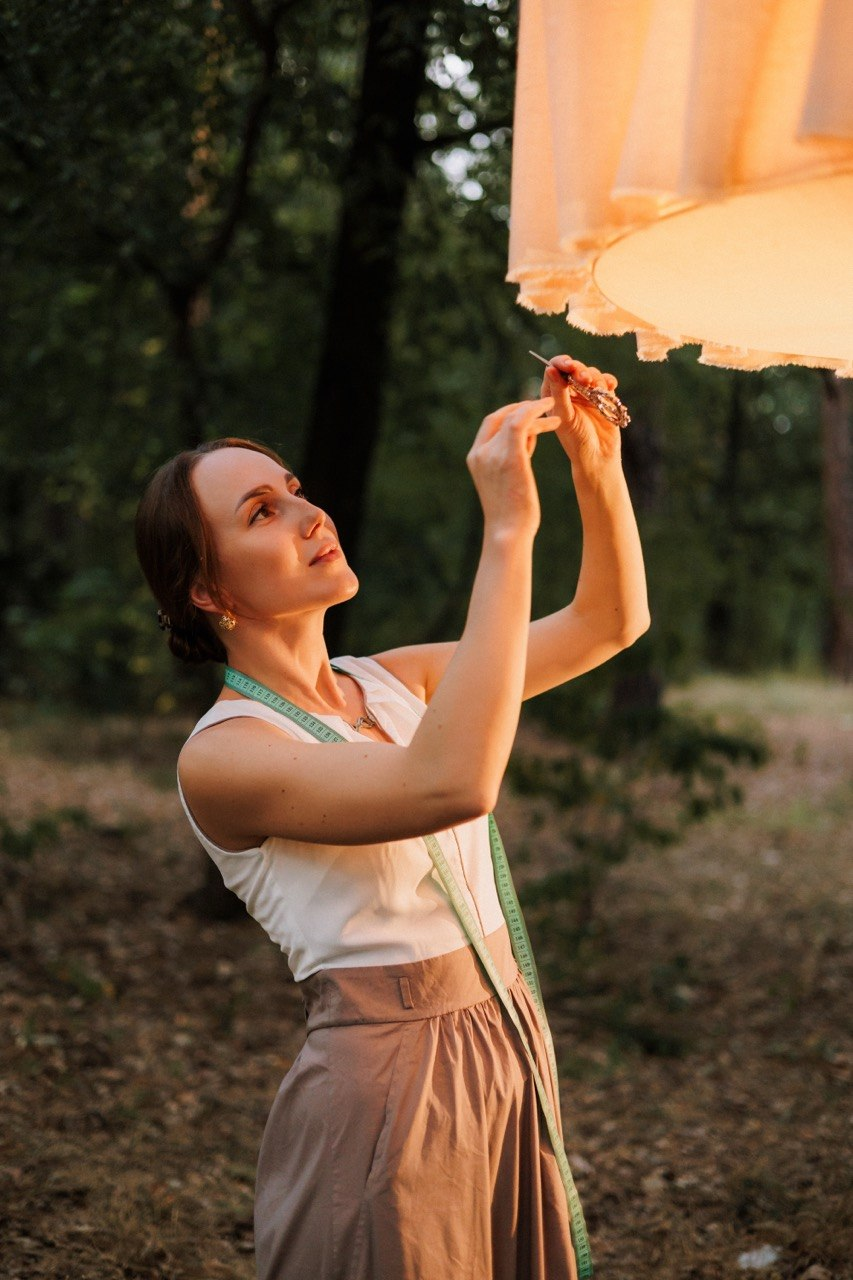
Objects, made by hand.
Object design grew naturally out of the studio's interiors.
When the right piece does not exist, Olga is often more interested in making it than settling for a compromise.
ZASMOLINA Atelier is developing a collection of lighting and objects made with fabric, clay and metal through hands-on processes.
Some begin within a specific interior. Others become the starting point for a room of their own.
Olga is also working with clay, developing hand-shaped objects that will soon join the Atelier's growing collection of collectible pieces.
The attraction lies partly in the material itself: clay never behaves with complete predictability. Small irregularities, traces of the hand and variations in the surface give each object a presence that industrial production cannot fully reproduce.
08
The pleasure of finding.
Olga is an avid collector and seeker of vintage pieces.
Old lighting, mirrors, furniture, ceramics, textiles, art and unexpected objects are constantly entering her visual vocabulary.
Antique markets, galleries, design fairs, exhibitions, showrooms and chance discoveries while travelling all become part of the search.
These objects bring something difficult to manufacture from scratch: time, individuality and the sense that an interior has been assembled over time rather than installed all at once.
Vintage, contemporary design, collectible pieces, premium brands and mass-market objects can all belong when they are carefully selected.
09
International practice.
ZASMOLINA Atelier develops projects in different countries without applying the same set of design solutions to each. Every project begins with a close reading of its context: architecture, climate, ways of living, local materials and culture.
In Milan, this may mean working with historic proportions, stone, mouldings and craft details. In California, it may centre on scale, natural light and the relationship between interiors and landscape. In the Gulf countries, privacy, climate and the culture of hospitality may guide the design.
The aim is not to make these spaces alike, but to understand their context in detail and create a contemporary interior that naturally belongs there.

10
Olga Zasmolina
Founder & Creative Director
Olga Zasmolina is the founder and creative director of ZASMOLINA Atelier.
She personally shapes the creative direction of each project - from planning and the initial concept to material palettes, custom furniture, lighting and objects.
Her interests extend far beyond interior design.
Art, fashion, architecture, travel, historical interiors, hotels, books, craft, vintage and exhibitions continually enrich her personal visual library.
Some references remain there for years before unexpectedly finding their place in a new project - not as literal quotations, but as a colour, proportion, material, detail or mood.
For Olga, the aim is not to repeat an already successful solution, but to find the one that belongs specifically to that place, that person or that brand.
Not one aesthetic for every space, but a different story for each.